

Improving sensor mounting in demanding installation conditions
AMBITIOUS is an EU project aimed at advancing digital innovation and sustainable development by leveraging artificial intelligence, 5G technology, and IoT solutions. Through technological development and collaboration with large enterprises and academic institutions, the project accelerates innovation and enhances the visibility and integration of SMEs into EU value chains. (Source)
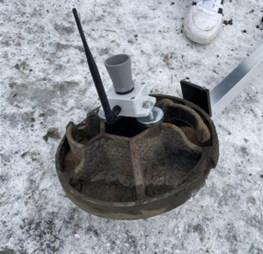
Practical installation work often reveals issues that cannot be fully anticipated. In the Ambitious project, this became evident in a situation where a sensor installed in a well detached and fell into the well when the lid was closed. The reason was simple: the old magnets could not withstand the stress caused by the lid.
The magnets under the lid gave way
At this site, the well lid was exceptionally tight. Pressing the lid into place caused a strong impact and vibration that was directed straight at the sensor. In this situation, the magnets in use could no longer hold, and the sensor detached and fell into the well. The incident clearly showed that the original magnetic solution was not strong enough under real installation conditions.
The sensor falling is not only an equipment risk, but also a safety and maintenance issue.
Stronger magnets as a solution to the holding force
The solution started with the magnets. They were replaced with significantly stronger ones, which eliminated the core issue: the sensor now remained securely attached to the well lid, even when the lid required forceful handling. At the same time, however, a new challenge was identified. The thread size of the new magnets differed from the sensor’s original mounting. The magnets could not be attached directly to the sensor, so simply replacing them was not enough. This made it necessary to develop a new mounting solution.
New mounting solutions – two functional options
To resolve the compatibility issue, two different mounting solutions were developed:
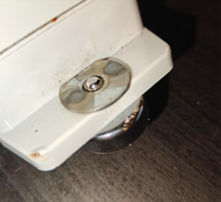
- A metal mount in which a washer and an M5 extension nut were welded together. This enabled a secure attachment of the new magnets and provided a highly durable solution, although machining the small parts required precision.
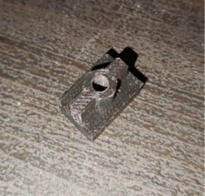
- A 3D-printed mount designed to fit directly to the sensor’s shape and equipped with an M5 thread. This solution was quick to produce, surprisingly durable, and easy to modify for further development.
Both options worked in practical testing and reliably kept the sensor in place.
Final result: a durable solution for real-world conditions
As a result of the development work, the sensor mounting now withstands situations where the well lid causes significant mechanical stress. The magnets no longer give way, and the mounting is compatible with the new components. This project is a good example of how real-world use reveals areas for improvement and how a problem can lead to a better, more reliable solution.
About the author

Kaapo Pehkonen
IoT Expert, Engineer (University of Applied Sciences)
+358 50 365 0240
kaapo[at]funlus.fi